


Table of Contents
A few months ago, someone reached out to me feeling frustrated.
“I’ve been doing SEO for six months. I’ve written blogs. I’ve built backlinks. But nothing is ranking.”
When I looked at the website, the problem wasn’t effort.
It wasn’t even consistent.
It was a direction.
They were doing SEO… but not the right type of SEO for their business.
That’s where most websites struggle.
SEO is not one single strategy. It’s a combination of different approaches. And unless you understand which type of SEO your website truly needs, you’ll end up working hard without seeing real results.
Let’s break it down clearly.
What Are the Types of SEO?
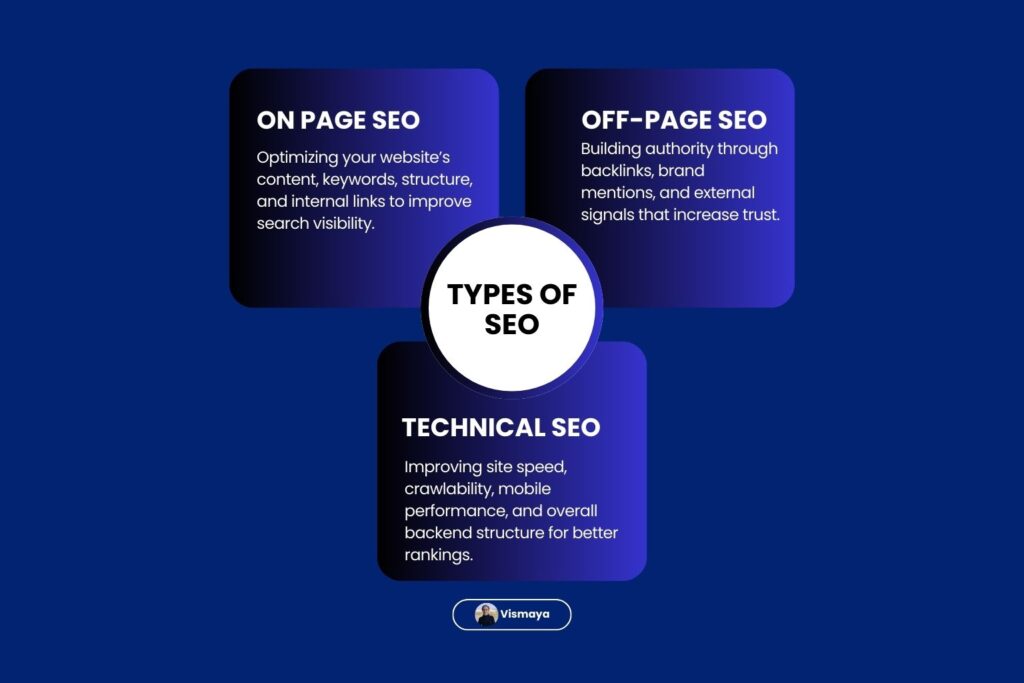
SEO (Search Engine Optimization) isn’t a single activity. It involves different types of work depending on where the optimization actually takes place.
At its core, SEO has three main pillars:
- On-Page SEO
- Off-Page SEO
- Technical SEO
These three work together. If one is weak, your rankings can suffer.
Beyond these, specialized SEO strategies depend on your business type, platform, and target audience.
Understanding these types helps you focus your time and budget in the right direction.
On-Page SEO
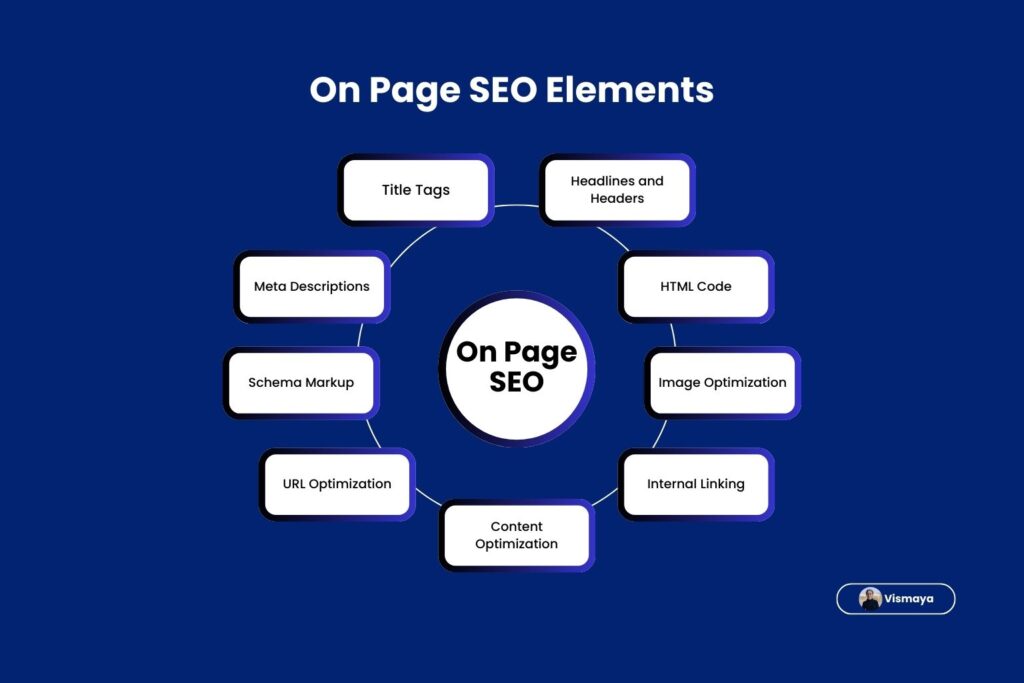
On-Page SEO focuses on everything you control on your website, from content to structure, helping search engines understand and rank your pages. It focuses on content, structure, and user experience.
Types of On-Page SEO Services
Here are the most important on-page SEO elements:
1. Keyword Research & Search Intent Mapping
Finding the right keywords based on what users are actually searching for and matching content to their intent.
2. Title Tag & Meta Description Optimization
Writing compelling and keyword-rich titles and descriptions that improve click-through rates.
3. Header Structure (H1, H2, H3)
Organizing content properly so both users and search engines can understand it easily.
4. Content Optimization
Improving depth, clarity, keyword placement, and readability.
5. Internal Linking Strategy
Connecting related pages to improve crawlability and distribute authority.
6. Image Alt Text Optimization
Helping search engines understand images.
7. URL Structure Improvement
Creating clean, descriptive URLs.
For example, if you write a blog titled “Best Running Shoes,” but don’t optimize it with proper headings, internal links, and relevant keywords, it may never rank even if the content is good.
On-page SEO ensures your content is structured for visibility, not just readability.
Off-Page SEO
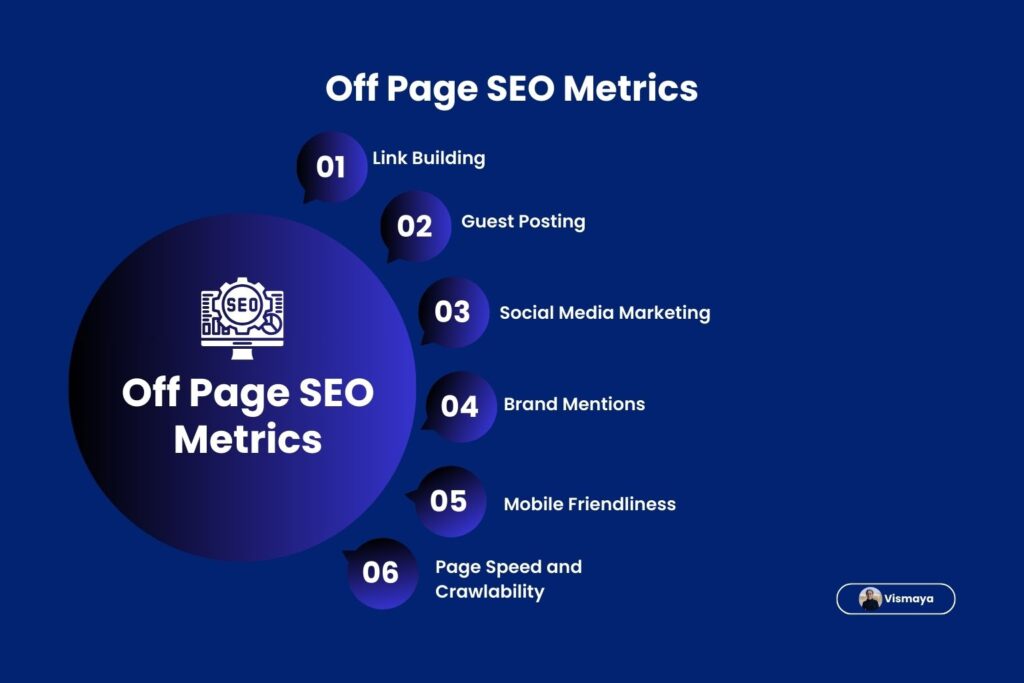
Off-page SEO is about everything that happens outside your website that helps build your credibility online. Search engines look at how other websites interact with yours.
The more credible signals you receive, the more trustworthy your website appears.
Common Off-Page SEO Activities
- High-quality backlink building
- Guest posting
- Digital PR
- Brand mentions
- Social sharing
- Google Business Profile optimization
For example, if a well-known marketing blog links to your article as a reference, that backlink acts as a vote of confidence. This contributes to how search engines assess the credibility of your content.
But here’s the important part:
Not all backlinks are good.
Low-quality or unrelated backlinks can negatively impact your search performance. Quality always matters more than quantity.
Technical SEO
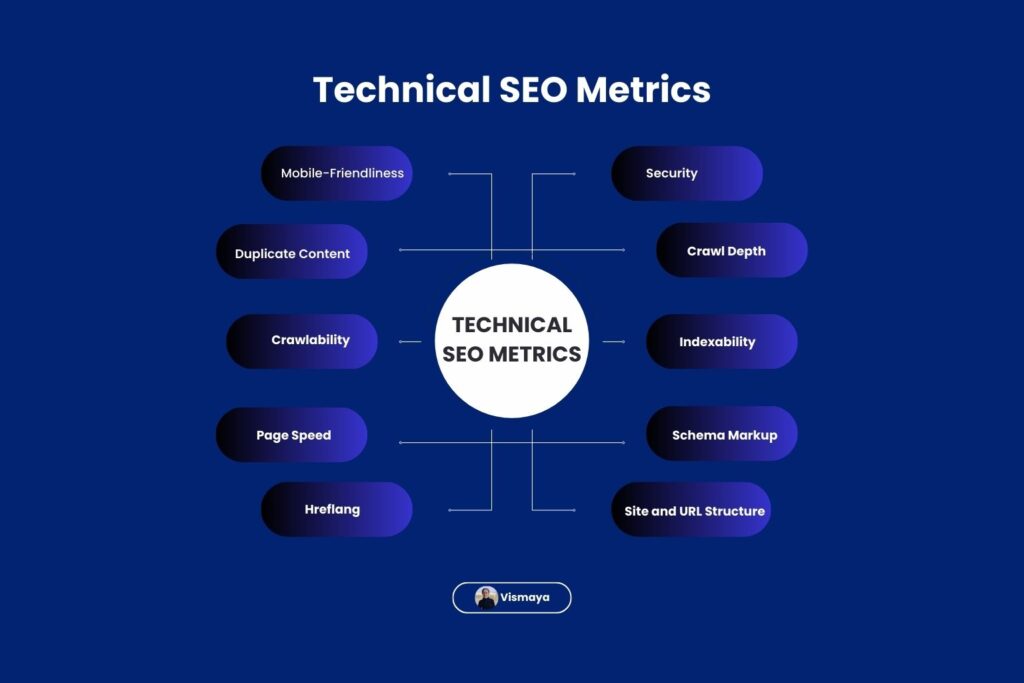
Technical SEO is about making sure your website runs smoothly in the background so search engines can easily access and read your content.
You can have amazing content, but if your site loads slowly or isn’t crawlable, rankings will suffer.
Common Technical SEO Tasks
- Improving page speed
- Optimizing Core Web Vitals
- Fixing crawl errors
- XML sitemap optimization
- Robots.txt configuration
- Implementing canonical tags
- Structured data (schema markup)
- Ensuring mobile-friendliness
- Securing a website with HTTPS
According to Google, Core Web Vitals are performance metrics that measure real-world user experience, including loading speed, interactivity, and visual stability.
Here is an Example of how to Strengthen Technical SEO:
- Start by checking your website in Google Search Console to identify indexing or crawl errors.
- Next, improve page speed by compressing images and removing unnecessary scripts.
- Make sure important pages are not blocked by robots.txt or marked as “noindex.”
- Finally, update your XML sitemap and ensure your website is fully optimized for mobile devices.
Small technical fixes like these can significantly improve how your website is evaluated and positioned in search results.
Other Types of SEO
Beyond the three main pillars of SEO, there are specialized strategies based on platform, industry, audience behavior, and technology.
These types of SEO become important depending on how your audience searches and how your business operates.
Let’s break them down clearly.
Image SEO
Image SEO focuses on optimizing images so they can rank in Google Image search and improve overall page performance.
Unlike humans, search engines can’t directly understand what an image shows. They rely on text signals to understand what an image represents.
It includes:
- Descriptive file names
- Alt text
- Image compression
- Proper image size
- Image sitemaps
When optimized correctly, images can drive additional organic traffic beyond regular search results.
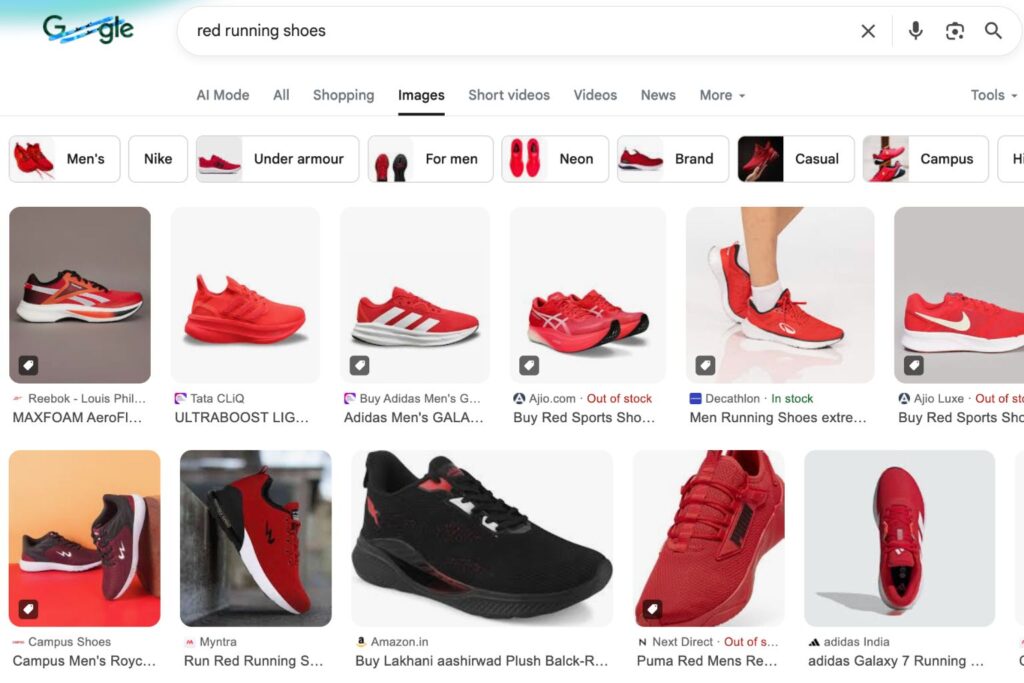
For Example, if you search for “red running shoes,” Google shows image results at the top. Those images rank because they have proper file names, alt text, and context.
If you upload an image named “IMG_1234.jpg,” search engines learn nothing.
But renaming it to “red-running-shoes-men.jpg” increases its visibility potential.
Image SEO improves both rankings and page speed, which directly impacts user experience.
Video SEO
Video SEO helps your videos rank on Google and video platforms like YouTube.
Search engines analyze video titles, descriptions, engagement signals, and surrounding content to determine relevance.
It includes:
- Optimized video titles
- Keyword-rich descriptions
- Tags
- Transcripts
- Video schema markup
- Engagement optimization
Videos can appear in regular search results, featured snippets, and video carousels.
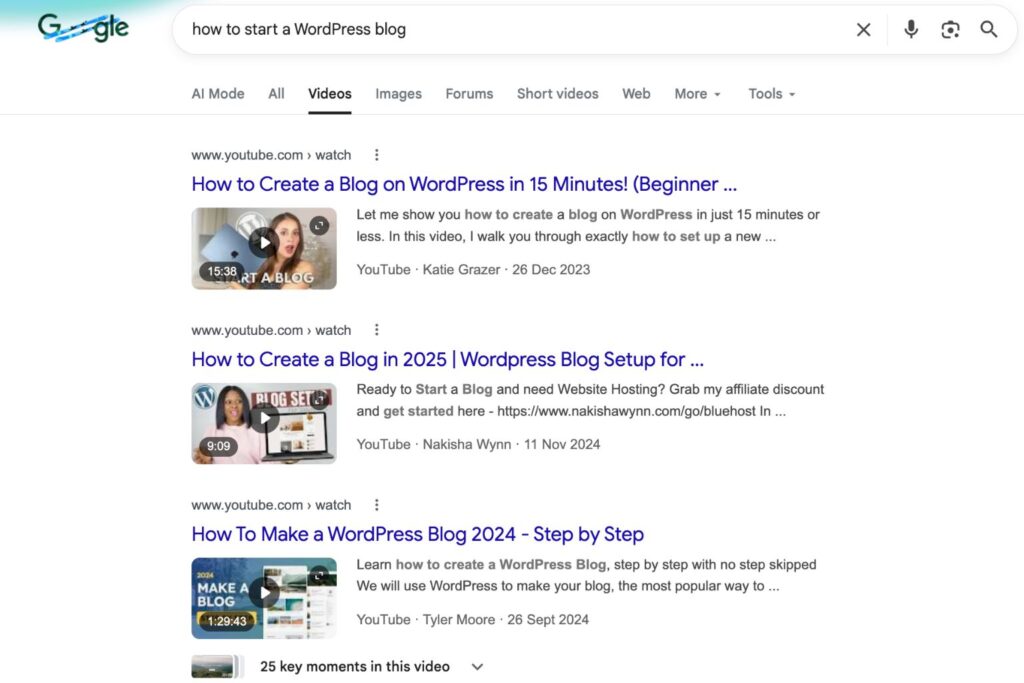
For Example, if you search for “how to start a WordPress blog,” you’ll often see video results on the first page. These videos rank because they clearly match search intent with optimized titles and descriptions.
A video titled “How to Start a WordPress Blog Step-by-Step” has higher ranking potential than a vague title like “My Blogging Tips.”
Video SEO increases visibility and keeps users engaged longer, which strengthens your brand authority.
Mobile SEO
Mobile SEO ensures your website works perfectly on smartphones and tablets.
Google uses mobile-first indexing, which means your mobile site plays a huge role in how your pages appear in search results.
Mobile SEO includes:
- Responsive design
- Fast mobile loading speed
- Optimized navigation
- Clickable buttons
- Proper font sizes
User experience plays a huge role here.
For Example, if users visit your website on mobile and struggle to tap buttons or read content, they leave immediately. This increases bounce rate and negatively impacts rankings.
A mobile-optimized website improves engagement and conversions.
E-commerce SEO
E-commerce SEO focuses on optimizing online stores to rank product and category pages.
Unlike blog SEO, e-commerce SEO requires structured optimization across hundreds or thousands of product pages.
It includes:
- Unique product descriptions
- Optimized category pages
- Product schema markup
- Reviews optimization
- Internal linking between products
- Managing faceted navigation
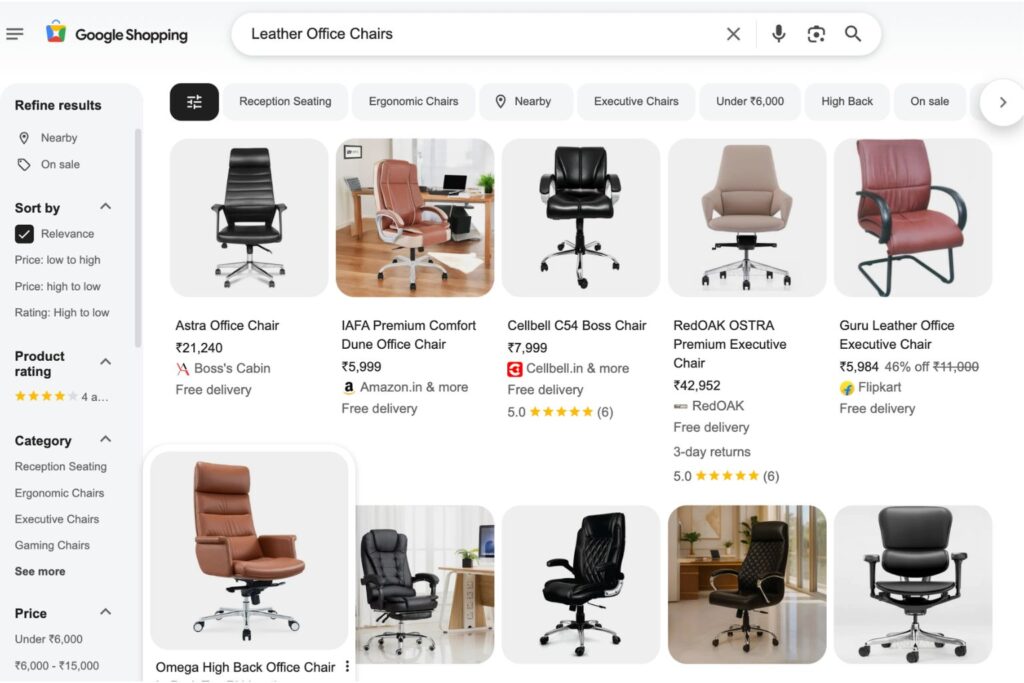
For Example, if you sell “Leather Office Chairs” but use manufacturer descriptions copied across multiple websites, search engines may not rank your product page well. Unique, structured content gives you a competitive advantage.
E-commerce SEO has a direct impact on revenue because rankings significantly influence purchase decisions.
Local SEO
Local SEO helps businesses appear in geographically targeted searches.
It is essential for service-based and location-based businesses.
It includes:
- Google Business Profile optimization
- NAP consistency (Name, Address, Phone)
- Local citations
- Location-specific landing pages
- Reviews and ratings management
Local SEO increases visibility in map results and local packs.
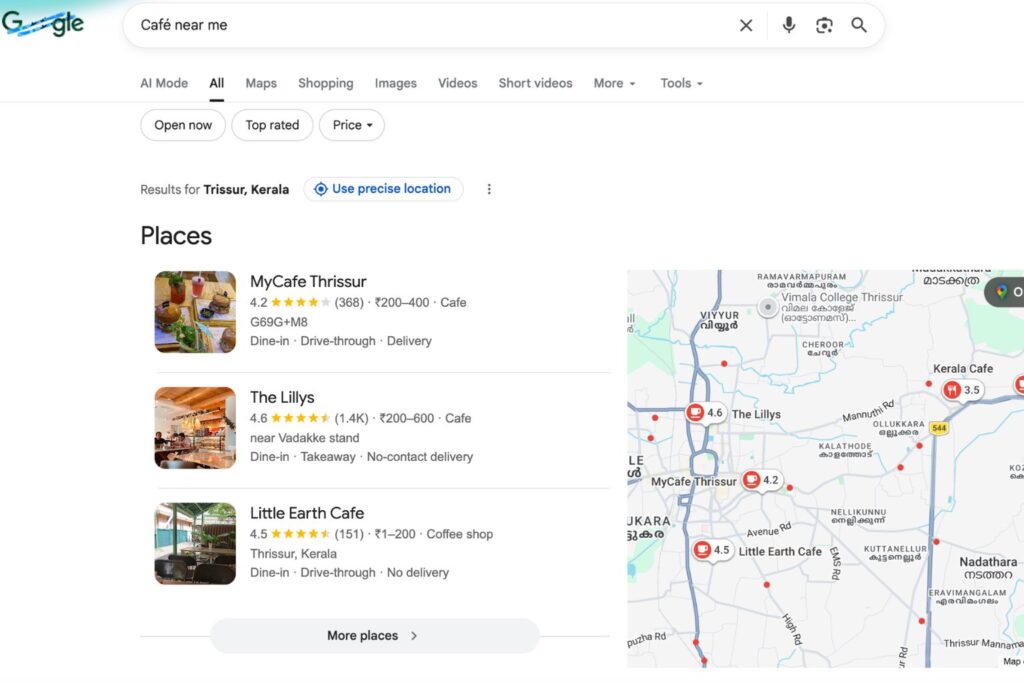
For example, if someone searches “best café near me,” Google displays a map with nearby businesses. The top three listings appear in the local pack.
Businesses with optimized profiles, strong reviews, and consistent information rank higher in these results.
Local SEO drives high-intent traffic. People searching locally are often ready to take action.
International SEO
International SEO helps businesses target audiences in multiple countries or languages.
It ensures search engines display the correct version of your website to users based on location or language.
It includes:
- Hreflang tag implementation
- Country-specific targeting
- Multi-language content
- Proper domain structure (ccTLD, subdomain, or subfolder)
Without proper international optimization, search engines may show the wrong language version to users.
International SEO improves global visibility while maintaining relevance for each region.
Enterprise SEO
Enterprise SEO is designed for large-scale websites with thousands of pages.
It requires advanced strategy, automation, and cross-team coordination.
It includes:
- Scalable content frameworks
- Automation tools
- Log file analysis
- Advanced technical SEO
- SEO governance policies
Enterprise SEO focuses on maintaining consistency across large digital ecosystems.
For large businesses, even small optimization changes can impact thousands of pages.
YouTube SEO
YouTube SEO focuses specifically on ranking videos within YouTube’s search algorithm.
YouTube considers factors like:
- Keyword usage
- Watch time
- Click-through rate
- Engagement (likes, comments, shares)
- Thumbnail appeal
A compelling thumbnail combined with high watch time can significantly improve ranking.
YouTube SEO is essential for brands using video as a primary content strategy.
Voice SEO
Voice SEO optimizes content for voice-based searches using assistants like Google Assistant or Alexa.
Voice searches are more conversational and question-based.
It focuses on:
- Natural language content
- Question-based keywords
- FAQ sections
- Featured snippet optimization
For example, instead of typing “weather Kochi,” users say, “What’s the weather like in Kochi today?”
Optimizing conversational queries increases your chances of appearing in voice search results.
AI Search SEO
AI Search SEO focuses on optimizing content for AI-driven search systems and generative search results.
Modern search engines analyze:
- Content structure
- Context and clarity
- Expertise signals
- Entity relationships
- Author credibility
Well-structured, informative content is more likely to be referenced in AI-generated summaries.
Clear formatting and topic authority are increasingly important.
White Hat SEO
White hat SEO involves doing things the right way, following best practices that help your website grow steadily over time.ines and focuses on long-term growth.
It prioritizes:
- High-quality content
- Ethical link building
- Strong user experience
- Transparency
This approach builds sustainable rankings and protects your website from penalties.
Black Hat SEO
Black Hat SEO uses manipulative tactics to gain quick rankings.
Common tactics include:
- Keyword stuffing
- Cloaking
- Link farms
- Private blog networks
These methods may deliver short-term results, but search engines can penalize or even de-index websites using them.
Long-term growth always depends on ethical practices.
How to decide which type of SEO you need?
Now comes the real question.
How do you actually decide which type of SEO your website needs?
Because here’s the truth, most websites don’t fail because they don’t do SEO.
They fail because they focus on the wrong area first.
You don’t need everything at once.
You need clarity.
And clarity comes from understanding three things:
- What your business model is
- Where your website currently stands
- What will create the biggest impact right now?
Let’s walk through this properly.
Step 1: Identify Your Business Model
First, be honest about what you are building.
Ask yourself:
- Are you trying to get local customers?
- Are you selling products online?
- Are you publishing content to drive traffic?
- Are you targeting multiple countries?
Then match it like this:
- If you run a local service business, your priority is Local SEO + On-page SEO.
- If you run an e-commerce store, focus on Technical SEO + Product page optimization.
- If you are a blogger or content creator, your focus should be on content depth + internal linking.
- If you run a SaaS or tech company, you need strong Technical SEO + authority building.
- If you operate in multiple countries, you need International SEO.
Don’t overcomplicate it.
Your business model decides your SEO direction.
Step 2: Audit Your Current Website (Do This Practically)
Now don’t guess. Check.
Here’s exactly what you should do:
- Go to “Pages” → Check how many pages are indexed.
- See if important pages are marked as “Crawled – currently not indexed.”
- Look for errors under “Indexing.”
If pages aren’t indexed, → You need Technical SEO first.
- Check your Site Health score.
- Look for broken links.
- Check for duplicate meta titles.
- Identify missing alt tags.
If there are many technical warnings, → Fix Technical SEO before anything else.
Crawl Your Website Using Screaming Frog
- Check for 404 pages.
- Find duplicate content.
- Look at the title tag length and missing H1s.
If your structure is messy → Focus on On-page + Technical SEO.
Test Your Speed in PageSpeed Insights
- Check the mobile performance score.
- Review Core Web Vitals.
If your website is slow → Technical SEO becomes your priority.
This is how you turn confusion into clarity.
These tools help you see what’s actually happening behind the scenes, not just what you assume.
An audit reveals gaps.
And once you see the gaps clearly, strategy becomes easier.
Step 3: Prioritize Based on Impact
Now that you’ve seen the issues, don’t panic.
Fix in this order:
First → Technical Issues
If your site is slow, broken, or not indexed, nothing else matters.
Second → On-Page Optimization
Improve content structure, headings, internal links, and keyword alignment.
Third → Authority Building
Start building quality backlinks only after your site is optimized.
Why?
Sending backlinks to a weak foundation is like pouring water into a leaking bucket.
Fix the bucket first.
Then fill it.
So, Which SEO Do You Actually Need?
There’s no single type of SEO that works for every website.
What really matters is understanding where your site stands and focusing on the type of SEO that will move it forward. When you get that part right, everything else becomes easier, your strategy feels clearer, and your efforts start to show real results.
Because in the end, SEO isn’t about doing more. It’s about doing what actually matters.